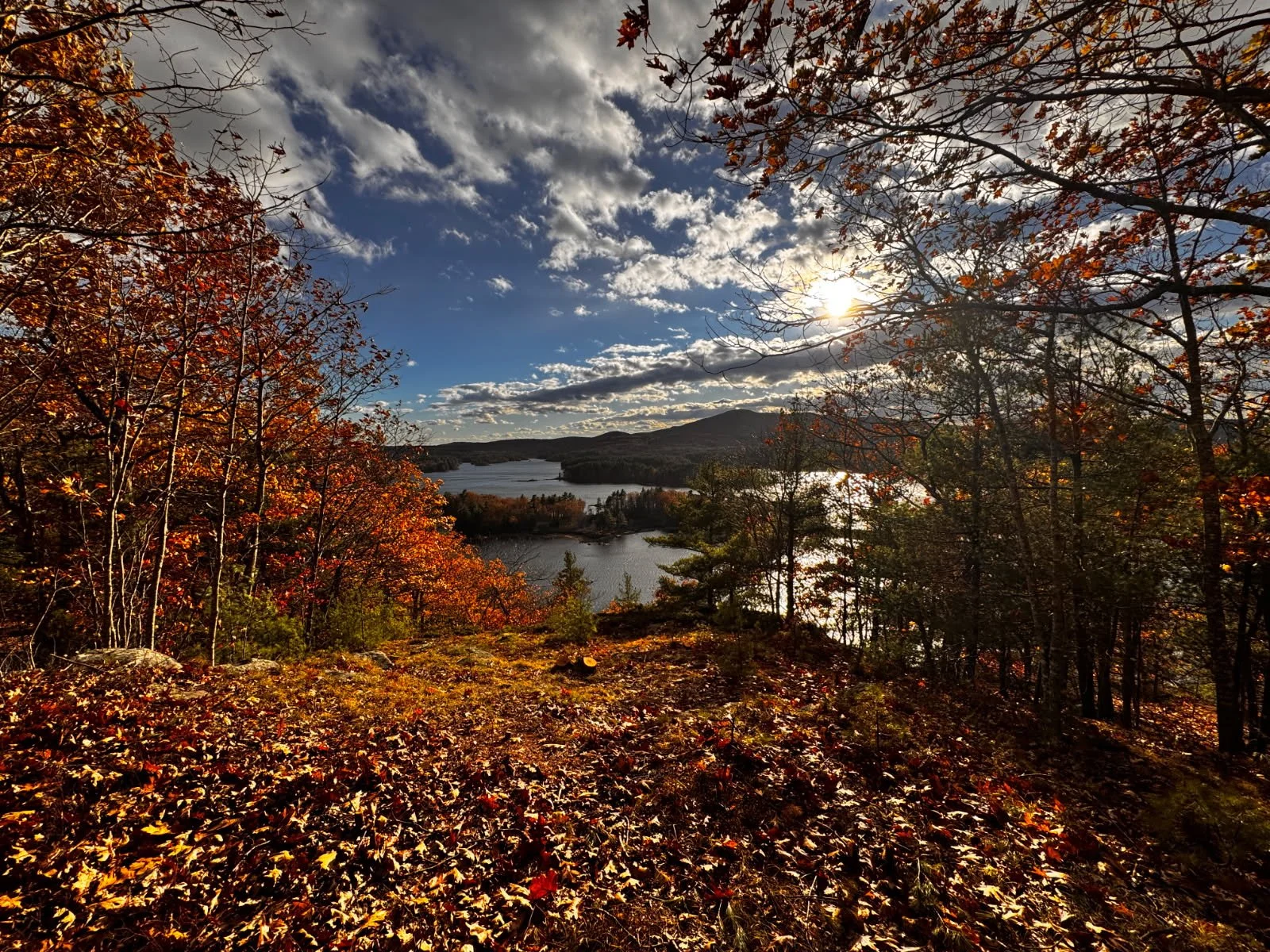

The Lincolnville Hills Project (LHP) was created to reestablish and maintain historic sites located within the Camden Hills State Park on the Lincolnville side. These include the Cameron Knob, Cameron Field, Poverty Knoll and Millerite Fields. These sites of historical relevance to the Lincolnville community were once used for agriculture before the land was incorporated into the state park system. Due to the lack of maintenance, access has become impeded, and the spectacular views and other significant values enjoyed by hikers and picnickers are close to being lost as the fields get overgrown.
The four sites constitute about 25 acres of rocky terrain, with underling mixed growth of wild low bush blueberry plants, wild flowers, grasses, ferns and a wide variety of other low-profile vegetation. This open habitat, in addition to maintaining spectacular views and recreational opportunities, provides important support to a wide variety of both permanent and transient wildlife that depend on this type of environment for their survival. It also provides areas of fire breaks in the event of forest fires.
Substantial progress has been made over the past few years to reestablish and maintain the targeted sites. This has been accomplished with the help and contributions of many townspeople, businesses and Camden Hills State Park (CHSP) management/staff. Key to this success has been the partnership support provided by the CHSP Director and staff, the LHP organization, and key Lincolnville citizens who have provided their time, equipment, skill sets and dedication to the effort. Although much has been accomplished, more remains to be done.
The LHP is an IRS code section 501(c)(3) organization (a nonprofit organization for general charitable purposes) to fund and oversee the conduct of the reestablishment and maintenance of these important sites. LHP board members are: David Kelly, pres., Dwight Emerson, sec., and Hayden Sears, treas. Additional information about the LHP can be obtained by email at: Dwight_Emerson@msn.com.
Town of Lincolnville
Select Board Resolution
October 24, 2022
Be it resolved that the town of Lincolnville supports the goal of recovering and maintaining historical Lincolnville hilltop sites that have been incorporated into the Camden Hills State Park system. These scenic historic sites continue to provide hikers, skiers, picknickers, birders, hunters, wildlife enthusiasts, and wildlife itself the necessary open space for multiuse recreation and fire protection. Preserving these historic sites, and the treasured values they provide the community, are important for both current and future generations.
LINCOLNVILLE HILLS PROJECT
Fall 2023 Report
The Lincolnville Hills Project (LHP) was created to reestablish and maintain historic sites located within the Camden Hills State Park on the Lincolnville side. These include the Cameron Knob, Cameron Field, Poverty Knoll and Millerite Fields. These sites of historical relevance to the Lincolnville community were once used for agriculture before the land was incorporated into the state park system. Due to the lack of maintenance, access has become impeded, and the spectacular views and other significant values enjoyed by hikers and picnickers are close to being lost as the fields get overgrown.
The four sites constitute about 25 acres of rocky terrain, with underling mixed growth of wild low bush blueberry plants, wild flowers, grasses, ferns and a wide variety of other low-profile vegetation. This open habitat, in addition to maintaining spectacular views and recreational opportunities, provides important support to a wide variety of both permanent and transient wildlife that depend on this type of environment for their survival. It also provides areas of fire breaks in the event of forest fires.
Substantial progress has been made over the past few years to reestablish and maintain the targeted sites. This has been accomplished with the help and contributions of many townspeople, businesses, friends of LHP near and far, and Camden Hills State Park (CHSP) management/staff. Key to this success has been the partnership support provided by the CHSP Director and staff, the LHP organization, and key citizens who have provided their time, money, equipment, skill sets and dedication to the effort. This Fall 2023 report highlights some of the activities completed this year in continence of the progress reported last fall.
The LHP moved forward on several fronts during the calendar year 2023. Although it was an extremely wet year, which restricted access to the targeted sites for much of the period, six work day events were conducted with a combined crew of over fourteen workers. In addition, a LHP volunteer, contributed the rental, operation and evaluation of a new piece of equipment for clearing overgrown areas at the Cameron Knob site. This large excavator, with an articulating mulcher head, was used over a variety of slopes, terrains and tree types. It was evaluated to be effective for clearing larger trees on moderate slopes and terrains. However, follow up work is required to handle the large amounts of debris this approach generates. We gained valuable experience on what the best approach was to keep different parts of each targeted area cleared after initial recovery had been accomplished. Rocks, wet spots, steep slopes and hummocks continue to present an ongoing challenge, but we learned a lot about which approach works best at specific locations. Much of the work was at the Cameron Knob site this year. It is estimated that about 35% of the roughly 10-acre site can now be maintained using tractor/brush hog technique, and 100% of the Cameron Field can be maintained this way.
We continue to develop a close working relationship with the CHSP personnel, both at the local and state level to further institutionalize the LHP for continuity with future participants. Plans for a display board at the Cameron Knob site, with a QR code for obtaining additional information and fund raising are also under discussion.
The LHP is an IRS code section 501(c)(3) organization (a nonprofit organization for general charitable purposes) to fund and oversee the conduct of the reestablishment and maintenance of these important sites. LHP board members are: David Kelly, pres., Dwight Emerson, sec., and Hayden Sears, treas. Additional information about the LHP can be obtained by email at: Dwight_Emerson@msn.com.
LINCOLNVILLE HILLS PROJECT
Fall 2024 Report
The Lincolnville Hills Project (LHP) was created to reestablish and maintain historic sites located within the Camden Hills State Park on the Lincolnville side. They include the Cameron Knob, Cameron Field, Poverty Knoll and Millerite Fields. These sites, of historical relevance to the Lincolnville community, were once used for agriculture before the land was incorporated into the state park system. Due to the lack of maintenance, access has become impeded, and the spectacular views and other significant values enjoyed by hikers and picnickers are close to being lost as the fields get overgrown.
The four sites constitute about 25 acres of rocky terrain, with underling mixed growth of wild low bush blueberry plants, wild flowers, grasses, ferns and a wide variety of other low-profile vegetation. This open habitat, in addition to maintaining spectacular views and recreational opportunities, provides important support to a wide variety of both permanent and transient wildlife that depend on this type of environment for their survival. It also provides areas of fire breaks in the event of forest fires.
Substantial progress has been made over the past few years to reestablish and maintain the targeted sites. This has been accomplished with the help and contributions of many townspeople, businesses, friends of LHP near and far, and Camden Hills State Park (CHSP) management/staff. Key to this success has been the partnership support provided by the CHSP Director and staff, the LHP organization, and key citizens who have provided their time, money, equipment, skill sets and dedication to the effort. This Fall 2024 report highlights some of the activities completed this year in continuance of the progress reported over the past two years.
One could say the LHP was really rocking during the calendar year 2024. In contrast to last year, which was extremely wet, access to the targeted sites was generally good and an emphasis was given to the removal of large rocks from the Poverty Knoll and Millerite Field sites. Removal of these rocks, which had been left due to their size when these areas were first cleared in the 1800’s, resulted in a significant improvement in the time and expense needed to maintain these sites going forward. Rock removal allows for tractor/brush hog equipment to work faster with less wear and tear on equipment. It is estimated that as much as a 50% reduction in time needed for site maintenance activities was achieved at these two sites. The combination of Hayden Sears’ mid-sized Kubota excavator and Rosey Gerry’s full size Kubota excavator achieved an optimal labor/equipment mix to remove rocks from over six acres during a two-day period. This equipment also allowed for the substantial improvement of access routes to the sites by the removal of large boulders and the construction of water diversion features to prevent soil erosion. Additional recovery activities were conducted at both the Poverty Knoll and Cameron Knob sites using a combination of CHSP staff with chain saws, volunteers, a wood chipper and a Kubota track skid-steer powered mulcher. David Kelley was successful in maintaining significant parts of the Cameron Knob and Poverty Knoll sites for the first time using his tractor and brush hog, and continued to maintain the Carmeron Field using that equipment. We continue to gain valuable experience on the best approaches to keep different parts of each targeted area cleared after initial recovery has been accomplished. Rocks, wet spots, steep slopes and hummocks continue to present an ongoing challenge, but we have learned a lot about which approach works best at specific locations.
Much work was accomplished at each site this year. It is estimated that about 50% of the roughly 10-acre Cameron Knob site has been recovered and about 35% of that can now be maintained using tractor/brush hog technique, and 100% of the Cameron Field can be maintained this way. The remaining 15% requires a combination of track steer mulcher and hand-held equipment. There remains about 20% of the recovered wood material to be chipped. It is estimated that about 50% of the Poverty Knoll site and 65% of the Millerite Field has been recovered and are now being maintained by a combination of trac steer and tractor/brush-hog technology. Fresh new blueberry vines are now in abundance at all the sites that are in maintenance mode.
We continue to develop a close working relationship with the CHSP personnel, both at the local and state level to further institutionalize the LHP for continuity with future participants. We participated in the first CHSP Outdoor Adventure Day event on August 31st, where we set up a display tent, presented information about the LHP and sold baked goods. Plans are underway for the development of a web site for the project and for a display board at the Cameron Knob site, with a QR code for obtaining additional information and submitting donations to the project.
We had a good year and much was accomplished, but the success came with costs. The equipment used experienced a variety of operational/maintenance issues. The terrain is hard on equipment. The Kubota trac skid-steer had a damaged trac that needed replacing, a hydraulic line was cut on a rock, cutting blades needed sharpening/replacement, check engine lights needed to be diagnosed and repairs made, fuel and parts costs increased, inflation was everywhere. We have a goal to raise $10,000 for next year’s activities. A generous anonymous donor has pledged to match up to $3,000 of the money raised by March 1, 2025. Thank you for your continued support.
Donations should be made out to “Lincolnville Hills Project” and addressed to:
Lincolnville Hills Project
c/o M. Hayden Sears, D.V.M., Treasurer
330 Youngtown Road
P.O. Box 47
Lincolnville, ME 04849
The LHP is an IRS code section 501(c)(3) organization (a nonprofit organization for general charitable purposes) to fund and oversee the conduct of the reestablishment and maintenance of these important sites. LHP board members are: David Kelly, pres., Dwight Emerson, sec., and Hayden Sears, treas. Additional information about the LHP can be obtained by email at: Dwight_Emerson@msn.com.
LINCOLNVILLE HILLS PROJECT
Fall 2025 Report
The Lincolnville Hills Project (LHP) was created to reestablish and maintain historic sites located within the Camden Hills State Park on the Lincolnville side. They include Cameron Knob, Cameron Field, Poverty Knoll, and Millerite Fields. These sites, of historical relevance to the Lincolnville community, were once used for agriculture before the land was incorporated into the state park system. Due to lack of maintenance, access has become impeded, and the spectacular views and other significant values enjoyed by hikers and picnickers are close to being lost as the fields get overgrown.
The four sites constitute about 25 acres of rocky terrain, with underling mixed growth of wild low bush blueberry plants, wild flowers, grasses, ferns and a wide variety of other low-profile vegetation. This open habitat, in addition to maintaining spectacular views and recreational opportunities, provides important support to a wide variety of both permanent and transient wildlife that depend on this type of environment for their survival. It also provides areas of fire breaks in the event of forest fires.
Substantial progress has been made over the past few years to reestablish and maintain the targeted sites. This has been accomplished with the help and contributions of many townspeople, businesses, friends of LHP near and far, and Camden Hills State Park (CHSP) management/staff. Key to this success has been the partnership support provided by the CHSP Director and staff, the LHP organization, and key citizens who have provided their time, money, equipment, skill sets and dedication to the effort. This Fall 2025 report highlights some of the activities completed this year, continuing the progress reported over the past three years.
2025 Progress Update
It has been a busy year for the LHP, with many activities to report. A web-site describing the LHP was developed (LincolnvilleHillsProject.org). In conjunction with CHSP, a display board was produced and installed at Cameron Knob. We participated in the CHSP Outdoor Adventure Day event, conducted a well-attended information presentation at the Lincolnville Library, and added two new board members (Sandy Cameron, webmaster and Becky Johnson, outreach coordinator). Substantial recovery progress was made at both Cameron Knob and Poverty Knoll, and maintenance of the prior recovered sections was completed. Check out the website for a more detailed description and pictures of what was accomplished this year.
Springtime brought an abundance of white blueberry flowers to both the Cameron Knob and Poverty Knoll sites where our recovery activities have restored the vines to productive capacity. Several reports of people picking blueberries were received. Our volunteer numbers continued to grow and the web-site has made it easier to make donations. We continue to gain experience with what equipment works best for the differing conditions within each of the sites. We are using detailed satellite photo maps for each of the sites to identify subsections for future planned actions.
The annual October 22ed hike up to the Millerite Ledges, in observance of the Day of the Great Disappointment, was very well attended and offered a good opportunity to showcase both the Millerite and Poverty Knoll sites. Dry conditions throughout the summer provided good access, but required special attention and precaution against fire hazard. Equipment continued to function effectively and the planning and organization of operations were conducted with the goal of continuing to improve efficiency.
Much work was accomplished at each site this year. It is estimated that about 65% of the roughly 10-acre Cameron Knob site has been recovered and about 40% of that can now be maintained using tractor/brush hog technique, and 100% of Cameron Field can be maintained this way. The remaining 25% requires a combination of skid-steer mulcher and hand-held equipment. It is estimated that about 65% of the Poverty Knoll site and 65% of Millerite Field has been recovered and are now being maintained by a combination of trac steer and tractor/brush-hog technology. Fresh new blueberry vines are now in abundance at all the sites that are in maintenance mode.
We continue to develop a close working relationship with the CHSP personnel, both at the local and state level to further institutionalize the LHP for continuity with future participants. The landscape architect, Hans Heistad, who planned what the CHSP was to become once said: “We don’t disturb nature, we just improve on it. We make a picture out of the material God has let us have.”
We had a good year. Much was accomplished and costs were kept within budget. The tractor, brush hog, skid-steer, mulcher, and excavator incurred normal operational/maintenance expenses. The chipper feeder needed a rebuild. Labor was voluntary, and other operating costs were covered either by participant contributions or donations. We met our goal of $10,000 for this year’s activities through one very generous anonymous donor, and a second donor that pledged to match up to $3,000 of the money raised during the year. Our goal for next year is $10,000. Thank you for your continued support.
Donations can be made either through our web-site, or by check made out to “Lincolnville Hills Project” and addressed to:
Lincolnville Hills Project
c/o M. Hayden Sears, D.V.M., Treasurer
330 Youngtown Road
P.O. Box 47
Lincolnville, ME 04849
The LHP is an IRS code section 501(c)(3) organization (a nonprofit organization for general charitable purposes) to fund and oversee the conduct of the reestablishment and maintenance of these important sites. LHP board members are: David Kelley, pres., Dwight Emerson, sec., Hayden Sears, treas., Sandy Cameron, webmaster, and Becky Johnson, outreach coordinator. Additional information about the LHP can be obtained at our website: www.Lincolnvillehillsproject.orgBig Ideas,
Real Impact.